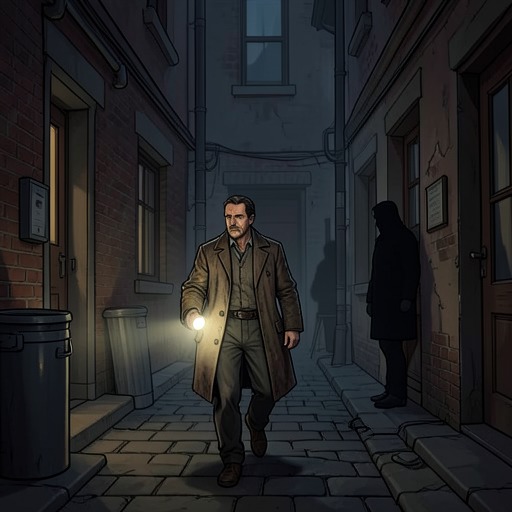
K. William Hodges—Brady Hartsfield
Mr. MercedesK. William Hodges and Brady Hartsfield are bound by an unfinished pursuit: Brady committed the City Center massacre without being caught, and then deliberately reached out to the retired detective whose failure he treats as a personal victory. Their contest is conducted at a distance, through a poison-pen letter, online contact, and competing efforts to anticipate the other. Brady means to turn Hodges’s retirement and despair against him; instead, the challenge gives Hodges a reason to act again, even as it exposes how vulnerable he has become.
Identity and the Unfinished Case
Before retirement, Hodges had solved hundreds of cases, including high-profile crimes, and his longtime partner Pete Huntley described him as both disciplined and intuitive. Brady’s letter makes the imbalance between that record and this one its central taunt: Hodges did not catch the man the press called the Mercedes Killer. Brady identifies himself as the driver who deliberately struck the City Center job-fair crowd, killing eight and injuring many others, and boasts that the attack exceeded his own expectations.
For Brady, the crime is not simply an unsolved case. He resents that Hodges retired with honors and received a plaque and a party despite failing to catch him. He imagines himself occupying Hodges’s thoughts during the retirement ceremony, making the detective’s public recognition feel like an insult to the killer who remains at large. The contrast supplies their conflict with its first personal charge: a celebrated career on one side, an uncaught mass murderer on the other.
The Letter and Its Intended Effect
Brady writes as though addressing Hodges directly, presenting the massacre as a triumph and describing the public fear that followed. He claims that he has no desire to repeat the attack and says once was enough, but his account of cancelled public gatherings makes clear that he knows how fear has continued beyond the crime itself. His letter also frames the two men as fellow retirees, a sardonic attempt to make a killer and a former detective sound like counterparts.
The apparent concession is part of the provocation. Brady’s letter carries an unmistakable suggestion that Hodges should kill himself, exploiting the detective’s existing thoughts about death. Hodges considers whether Brady could have seen him handling his father’s .38 or putting it in his mouth, and recognizes that he has left the living-room shades open. The possibility that someone might observe him turns private despair into a vulnerability Brady may be using against him.
Brady expects the letter to revive Hodges temporarily. He has deliberately adopted a prose style unlike his own and judges the chance that the letter will give the old cop useful information to be nearly nonexistent. His plan is psychological as much as investigative: he expects Hodges to become energetic, make no progress, and suffer a sharper fall when the lead goes nowhere. The letter is bait for a longer game, not an accidental disclosure.
Two Competing Plans
Hodges does not respond by surrendering to the despair Brady hopes to deepen. As he reflects on the letter, he wonders what its author would think if he knew that it had given the former detective a reason to live, at least for a while. The reversal is central to their relationship: Brady intends to direct Hodges toward self-destruction, but the provocation instead renews his attention to the case and restores a sense of purpose.
Brady, meanwhile, keeps the contest at the center of his own plans. While working as an ice-cream-truck driver and taking Cyber Patrol calls, he considers whether a truckload of treats could be poisoned, researches the possibility, and decides against it. He judges the scheme possible but stupid, because he does not want to be caught and has other work to do. That work, he says to himself, is Hodges. He imagines returning to a route with poisoned ice cream only after the ex-cop has used the gun beside his chair, making Hodges’s death a condition of a future plan rather than a passing thought.
The fixation also changes what Brady considers worth risking. He notes that he took a chance with the Mercedes massacre and escaped, but no longer wants to endanger himself before finishing his business with Hodges. His repeated preference for safety is therefore not a withdrawal from the contest: it is a method of preserving the opportunity to manipulate his opponent. When he returns to the truck after serving a child, he keeps to the speed limit, a mundane precaution set against the violence he has already committed and the danger he continues to contemplate.
The Investigation Reopens
Hodges’s renewed interest becomes action when he considers the papers left by Olivia Trelawney. Since Janelle Patterson inherited Olivia’s estate and remained in town, Hodges reasons that she may have Olivia’s personal papers, including correspondence from the person who has contacted him. He wants to see any such letters. He also knows the ethical and legal problem: he is no longer a policeman, and pursuing evidence while withholding it crosses the bounds he once enforced.
Even so, he does not intend to stop. Brady’s arrogant letter angers him, but he recognizes that the anger has been useful because it has given him purpose after months of aimlessness. Hodges privately resolves that if he makes progress, he will turn the matter over to Pete Huntley. This intention marks the difference between the two men’s tactics: Brady seeks to provoke and control from concealment, while Hodges begins to follow a lead, aware that his unofficial role is compromised and that the proper police investigation remains with his former partner.
The work also offers Hodges an alternative to the passive routines of retirement. When Janelle offers five thousand dollars a week, with expenses and an eight-week minimum, he briefly imagines the trappings of a classic private detective: a small office, a receptionist, a trench coat, and a brown fedora. He dismisses the fantasy, but not the attraction of working again. His unfinished police cases and the Mercedes killer’s challenge make the prospect of investigation more compelling than staying in his chair.
Reversal, Threat, and Continuing Pursuit
Brady’s attempt to steer the relationship reaches an explicit threat when, after regaining control of himself, he logs on to Debbie’s Blue Umbrella and sends Hodges a brief message: “I’m going to kill you. You won’t see me coming.” The directness contrasts with the earlier letter’s elaborate taunting and confirms that the online contact is not merely a retrospective boast. Brady intends the message to place Hodges under threat while preserving the advantage of an unseen attacker.
The contest therefore reverses the emotional purpose Brady assigns it. He thinks of Hodges as the ex-cop he must make use the gun; Hodges experiences the challenge as a summons back into investigation. Brady’s confidence that he can direct the detective’s thoughts meets a man who has begun to recover direction precisely because he is being addressed by his enemy. Neither has yet resolved the pursuit in the evidence presented here: Brady remains uncaught and continues to threaten, while Hodges’s inquiry is active, unofficial, and increasingly consequential.
Their relationship joins the detective-story pursuit to a struggle over agency. Brady treats Hodges’s retirement, loneliness, and susceptibility to despair as openings through which he can control the older man. Hodges’s response is not yet a capture or a clean return to police authority; it is the decision to investigate despite those vulnerabilities and despite knowing that he is crossing professional boundaries. The cat-and-mouse contest begins as Brady’s boast about a case Hodges failed to solve, but becomes a source of renewed purpose for the detective and a threat that neither can afford to ignore.